
The Fault in Your Stars (and How Rounding Fixes It)
Designing a Feedback System: How I Learned About Banker’s Rounding

Let’s say you’re making a Feedback Management System that involves star ratings. This will likely give the user a Likert scale to score their feedback. Once the input is collected, you calculate the mean and round the numbers to obtain an average rating. For the sake of simplicity, you can take up to one decimal value for float values. Then you specify how to round those numbers.
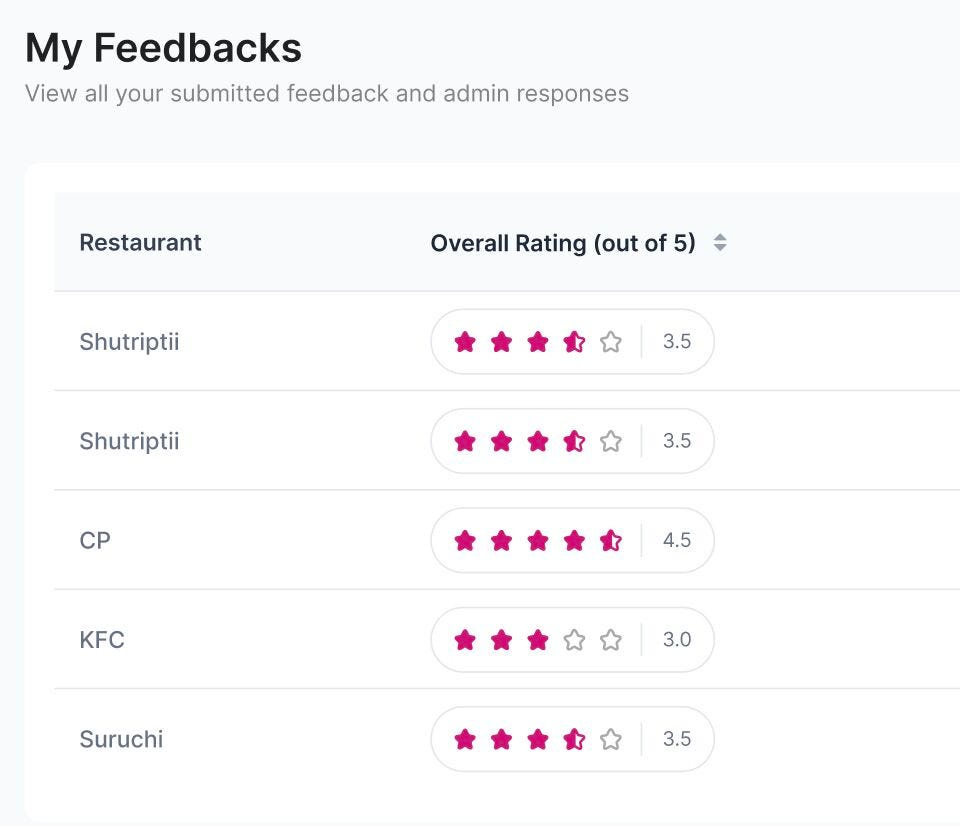
Generally, the default rounding method specified by the IEEE 754 standard for floating-point arithmetic is called the Banker’s Rounding Rule.
It’s quite simple:
The rule is based on the digit immediately preceding the 0.5 (the rounding digit).
◀️ 4️⃣ If the fractional part is less than 0.5 (e.g., 1.4): round down (standard rule).
▶️ 6️⃣ If the fractional part is more than 0.5 (e.g., 1.6): round up (standard rule).
🟰 5️⃣ If the fractional part is exactly 0.5 (the tie-breaker): round to the nearest even digit. (This deviates from the standard rule that most of us are used to.)
🔎 You might wonder (I did) why the tie-breaker rounds to the nearest even digit.
⚖️ This is done to reduce bias.
📈 Standard rounding (“round half up,” where 1.5 stars → 2 stars and 2.5 stars → 3 stars) introduces a slight upward bias because 0.5 stars is always rounded up.
⁉️ Over thousands of calculations (as in 💹 financial modeling, 🔣 statistical analysis, or 🧮 large-scale computer processing), this small upward bias can accumulate into a significant error in the final total.
Banker’s rounding solves this by forcing the halfway values to alternate between rounding up and rounding down. Statistically, for a large set of numbers ending in 0.5, approximately half will round up (the odd numbers) and half will round down (the even numbers), thus making the overall rounding bias close to zero.
I learned this while using my AI assistant(s) to write an SRS (Software Requirement Specification). You can use AI all you want to make work easier, and still learn something new every day!
Couldn't agree more. Thank you for realy articulating the critical difference Banker's Rounding makes in reducing bias, it's something I often emphasize to my students when we discuss data processing and algorithmic fairness. It's profound how a seemingly small detail like a rounding rule can have such significant, far-reaching implications across vast datasets.